The Knot Garden and Its Patterned Past
Knot garden patterns become easier to read when you know what to look for. Trace their apparent crossings, materials and changing historical forms.
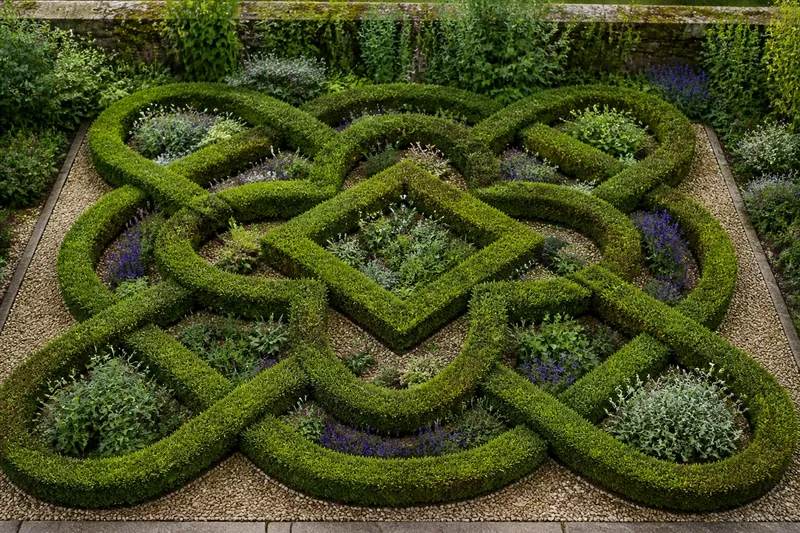
The common mistake with a knot garden is to treat it as a maze in miniature. Knot garden patterns are meant to be read as ornament from a viewpoint that reveals the whole bed; mistaking them for routes obscures the design’s interlacing lines. Follow one band with your eye and the garden’s organising idea becomes clearer.
Apparent crossings make the knot
A knot pattern uses looping bands that seem to pass over and under one another. The lines need not physically cross: a curve appears to tuck behind its neighbour, then emerge again. That visual device gives the design the character of a woven surface laid flat on the ground.
Look for repeated loops, paired turns and a balanced arrangement around a centre or within a border. A simple pattern can be convincing if its bands remain distinct. Clipped shapes without apparent crossings may belong to a parterre or another formal layout instead.
To read the design, stand where the whole bed is visible and trace a single band with your eye. Follow it around each turn and notice where it seems to pass behind another. The apparent crossing, not just the outline, makes the knot recognisable.
Ornamental design connects garden and craft
The interlacing lines recall the ordered repetition of woven textiles, embroidery and ornamental borders. This is a useful visual comparison, not proof that a particular garden copied a particular object. Knot designs translated a taste for patterned ornament into a planted surface.
Clipped lines also make visible the gardener’s shaping of growth. The outline is planned, but the plants remain living material: leaves grow, colours shift with the seasons and the finished appearance depends on continued care. That combination gives the form both a clear design and a changing surface.
Materials decide how clearly the lines read
Different materials produce different effects. Low clipped shrubs create raised edges; herbs can contribute scent and texture; flowers soften the geometry with seasonal colour. Gravel or another contrasting surface can separate the bands from the spaces between them, though it makes the pattern a composition of planting and ground rather than foliage alone.
When looking at a knot garden, ask what is doing the visual work: the height of an edging, a contrast in leaf colour, the division between foliage and gravel, or the repeated shapes of the plants. This helps you follow the design even if some sections look uneven.
It is not worth guessing the exact plant from a distant view. Clipping, replacement and the season can change what is visible; read the geometry first and treat plant identification as a separate question.
A knot is a pattern to view, not a puzzle to solve
A knot garden is chiefly designed to be looked across, not walked through as a route. Its repeated turns may look complex, but visitors do not need to choose a path or solve a puzzle. It is closer to a patterned panel than a labyrinth.
Repetition gives the composition coherence. A motif may recur in mirrored pairs or continue around a central space, creating a rhythm for the eye. A tidy, legible outline matters more than adding ever more loops.
Say you encounter an invented rectangular bed with matching loops on each side of a central diamond. If a spreading plant obscures one loop, the repeated rhythm becomes harder to follow. Tracing the intended band and noticing where the growth interrupts it gives you a clear reading of the design; the example describes a way to look, not a historical layout.
Viewpoint reveals the whole composition
From ground level, a knot can look like a tangle of edges. A terrace, upper window or raised path may reveal its crossings and repeated motifs more clearly. The elevated view lets you take in the composition rather than encounter it only as separate plants.
When visiting, first find a permitted viewpoint that shows the full bed, then compare it with the view from its edge. Notice whether the bands remain understandable from both positions. The spaces between them matter too: they are part of the design, not leftovers.
Historical identity depends on more than a clipped outline
“Knot garden” describes a family of designs rather than one fixed plan. The interlacing idea can be adapted to different scales and materials, and a present planting may reinterpret an earlier layout instead of reproducing it. Without reliable site documentation, appearance alone cannot establish when a particular design was made or how it has changed.
When comparing gardens, distinguish the pattern from its current planting. Ask whether the bands still appear to interlace, whether motifs repeat and whether the materials work together visually. A garden may retain the knot’s characteristic grammar even if the plants differ from those in an earlier version.
A neat clipped outline by itself is not evidence of age. Treat historical claims about an individual garden as questions for its site records or interpretation, rather than conclusions drawn from a single view.
What should you look for in a knot garden?
How is a knot garden different from a maze?
A knot garden is primarily viewed as a pattern; a maze is designed as a route with turns and choices. Its apparent crossings create visual complexity, not a walking puzzle.
What plants can form the bands?
Clipped shrubs, herbs and flowering plants can all shape the bands, while gravel or another contrasting surface may define the spaces between them. The materials change the texture and clarity of the design.
Does every knot garden use the same plan?
No. Interlacing lines and repeated motifs are the shared visual features, not a standard layout. The arrangement, scale and materials can vary.
Where is the best place to view one?
Start from a permitted raised or distant position where the complete design is visible, then look from the edge. The overview reveals the pattern, while the closer view shows how plants and surfaces make its lines.
Trace a band to read the design
Knot garden patterns are easiest to understand when you identify a repeated motif, follow an apparent crossing and notice how the planted bands differ from their infill. This approach works whether the edging is herbal, clipped or combined with gravel.
At your next visit, find a viewpoint that shows the whole bed and choose one band to follow. As its turns begin to read as a woven design, the plants stop looking like a collection of separate specimens and become part of the pattern.