The Garden Axis: How a Straight View Can Organise a Walk
A garden axis can give a walk a clear destination. Learn how to choose a sightline, test it on foot and keep the route rewarding along the way.
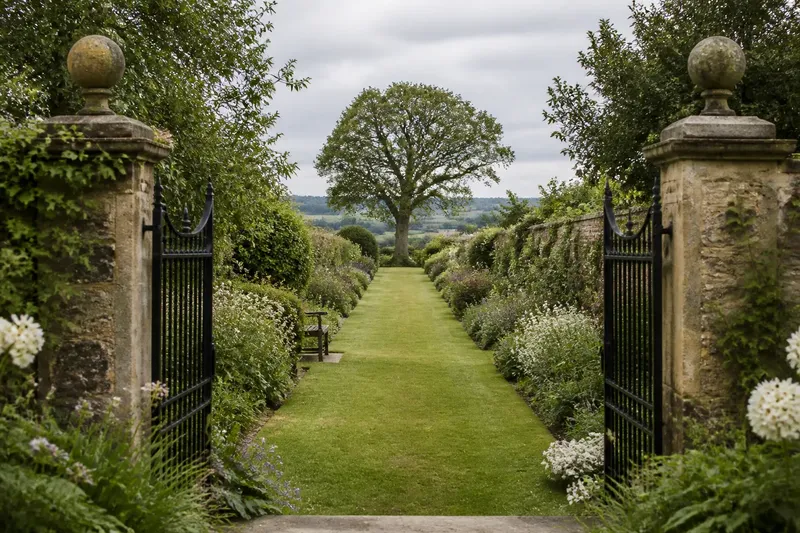
The common mistake with a garden axis is to draw a straight line on a plan and assume the walk will feel purposeful. If the view ends at a blank hedge, or the route offers nothing before it, visitors may simply see a long corridor with nowhere compelling to go. A garden axis works best when its line of sight and its walking route support one another.
Think of the axis as a visual connection between places: perhaps a gate and a distant tree, a doorway and a sculpture, or a path and a glimpse of water. The route need not be perfectly straight, and the destination need not sit at its far end. What matters is that a visitor can recognise the direction, move towards it, and find the view changing as they go.
Give the idea time to develop over a week. Each visit can answer a different question: what is already visible, where should the line lead, how does a person approach it, and what should happen when the destination is reached? A notebook, a simple plan, a length of string and a few temporary markers are enough to make useful decisions before planting or building.
Start by recording the views already in the garden
On the first day, stand at the places where a walk naturally begins: the house door, a garden gate, a terrace or the opening between two hedges. Look out at eye level. Note the feature your gaze reaches first and what lies directly behind it. Existing views can suggest an axis more convincingly than a line imposed on the ground.
Record the view from more than one position. A fine tree may appear central from a window but slip behind a shed when approached along the path. A bench may frame a distant opening while facing the wrong way for someone arriving from the gate. Make a quick sketch for each viewpoint and mark the visible features, not just the paths.
Also note what changes with ordinary movement. A turn in the route may reveal a doorway; a low wall may hide the destination until the visitor draws closer. These shifts can give a walk rhythm. The axis does not need to reveal everything at once. It should offer enough direction to invite movement, then allow the view to unfold.
Keep the first day’s observations plain. Avoid deciding that a view must be kept simply because it looks attractive from one spot. The useful question is whether it helps connect a place of arrival with a place worth walking towards.
Choose a destination that can carry the view
On the second day, choose a clear visual anchor. It might be an existing feature, such as a mature tree, a garden seat, a gate in a wall, a birdbath or a bright opening beyond a border. A modest feature can serve well if its outline is easy to recognise from a distance.
Ask what the anchor does for the walk. A seat suggests a pause; a gateway implies passage; a tree offers a changing silhouette through the seasons. A focal point that has a reason to be there is more satisfying than an ornament placed only to complete a line. If the feature is distant or partly hidden, decide whether the concealment is intentional or whether it simply makes the destination hard to read.
Consider the view in both directions. The outward sightline may end at a pergola, while the return view takes in the house or an older tree. A good axis can organise a walk without making the garden feel as though it has only one correct direction. A side path, a seat turned towards a different prospect or a gap in planting can preserve choice.
Say you have a gate at the near end of a lawn and a broad-crowned apple tree beyond it. You might choose the tree as the visual anchor, then set a small seat off to one side so the walk leads towards the gate without forcing every visitor to stop in the same place. From the seat, the tree remains visible, while the route also offers a view back across the lawn.
Test the line on foot before committing to it
On the third day, mark a possible route with temporary cues. Use garden canes with safe, visible tops, small flags, or string laid flat where it will not catch anyone. Keep markers away from the usual walking route until you are ready to inspect them, and remove them afterwards. The aim is to test the idea, not to create a hazard or a finished feature.
Walk the proposed line from each end. Notice whether the destination stays in view, disappears at a useful moment or is blocked by an unwanted object. Check whether the ground naturally leads the feet along the same direction as the eye. If the path bends, the sightline can continue straight across a lawn or through a gap in planting, but the connection should still be legible.
Then walk at an unhurried pace. A route that seems clear on a plan may feel exposed, cramped or dull at walking speed. Notice where you instinctively slow down, turn your head or want to stop. Those points may call for a wider view, a place to pause or a small change in the route.
Do not spend time making every border symmetrical around the axis. A tree, a change in paving or a framed opening can establish direction without mirroring the planting on both sides. Exact balance is not worth the effort if it makes the garden feel stiff or requires removing features that already give the space character.
Shape the edges so the view reads clearly
On the fourth day, look at what sits beside the line. The edges guide attention: a pair of clipped hedges can make a formal passage, while one low border and a loose planting group can point towards the same destination with less ceremony. There is no need for two identical sides. A clear foreground and a visible anchor usually matter more than matching shapes.
Use height with care. Tall planting or walls close to the route can frame a distant feature, but they may also hide it until the visitor is almost there. Lower planting near the main sightline keeps the anchor visible; taller growth can stand farther out, where it adds enclosure without blocking the view. Before changing established plants, consider their seasonal form as well as their appearance in leaf.
Surface can reinforce the route. Gravel, brick, mown grass or stone paving each gives a different impression underfoot, and a change in surface can signal a threshold or pause. Let the material suit the garden and its use. A straight view does not require a straight strip of paving, nor does every route need a hard edge.
Look for visual clutter as well as planting that is too high. A stored pot, garden hose or bright tool can compete with the intended destination when seen from a doorway. Move loose objects that have no reason to be in the view, but do not clear away every incidental detail. A garden should remain usable, not staged as a permanent picture.
Make the route reward approach and arrival
On the fifth day, consider what a visitor encounters before reaching the destination. If the anchor is visible from the start and remains unchanged, the walk can feel like a mere interval between two points. Let the view develop through a slight turn, a narrowing opening or a change in the planting beside the path. The route can reveal more without hiding its direction entirely.
Plan a reason to linger at the destination. A seat should face a view that can be enjoyed while sitting, not only while standing on the path. A gate should open onto somewhere the visitor can actually enter. If the anchor is a tree, leave enough room around it to pause without blocking the route. The endpoint should complete the walk rather than simply stop it.
Imagine that the apple tree in the earlier example is visible from the gate, but a shed roof intrudes into the view halfway across the lawn. You could shift the path’s approach so the shed falls behind a low planting group, then place the seat just off the route beneath the tree’s outer canopy. The expected result is a view that becomes clearer as someone walks, with a usable place to pause on arrival; the change does not depend on hiding the shed from every other part of the garden.
Review the axis through a full week
On the sixth day, revisit the route in different conditions. A bright morning may make a pale wall stand out, while an overcast afternoon brings out the shape of a dark evergreen. Look from the house, from the gate and from the destination. If possible, repeat the walk when the garden is being used in its ordinary way, with doors opening and tools or chairs in their usual places.
On the seventh day, make only the changes supported by what you have observed. Adjust a temporary marker, shift a seat, open a view through existing planting or reconsider the anchor. If the line feels forced, choose a different starting point or destination rather than adding more objects to explain it. The simplest arrangement that makes the walk understandable is often the strongest.
When planting, paving or altering a boundary, check the relevant plant labels, maker’s instructions and local rules where they apply. For a small garden, drawing the axis on paper and marking a short trial route may be all that is needed. For a larger space, compare the view from several approaches before settling on a permanent change.
What should the garden axis connect?
Does a garden axis have to be perfectly straight?
No. The axis is a visual line, while the walking route can curve or shift. A bend can make the destination appear gradually, provided the connection remains clear enough to guide the visitor.
Can the focal point be an existing tree or gate?
Yes. An existing feature often gives the view a more natural purpose than a new ornament. Check that it is recognisable from the chosen starting point and still makes sense when approached.
What if the destination is not visible from the start?
A partial glimpse can create a reason to continue, especially if the route reveals more along the way. Make sure the visitor can still understand the direction of travel rather than being left to guess where the path leads.
Does an axis need matching borders on both sides?
No. Repeated planting can strengthen a formal approach, but a one-sided border, low wall or group of shrubs can also guide the eye. Choose the arrangement that suits the garden’s existing character.
Keep the line useful as the garden changes
Use the phrase garden axis as a prompt to review a connection, not as a demand for permanent symmetry. Plants grow, furniture moves and a doorway may become a more important point of arrival. Check the view from its starting place as the seasons change, then make a small adjustment if the destination has become obscured or the route no longer feels inviting.
A successful straight view does more than draw the eye towards a distant feature. It helps a visitor understand where to go, gives the walk a sequence and leaves room for the garden to be enjoyed in other directions. Keep one clear visual invitation, make the approach comfortable, and let the rest of the space remain open to discovery.