Bulbs or Tubers? Two Different Ways Plants Store Their Start
Bulbs or tubers are easy to confuse. Learn to spot layers, eyes and crowns so you can name underground plant parts and understand where new shoots emerge.
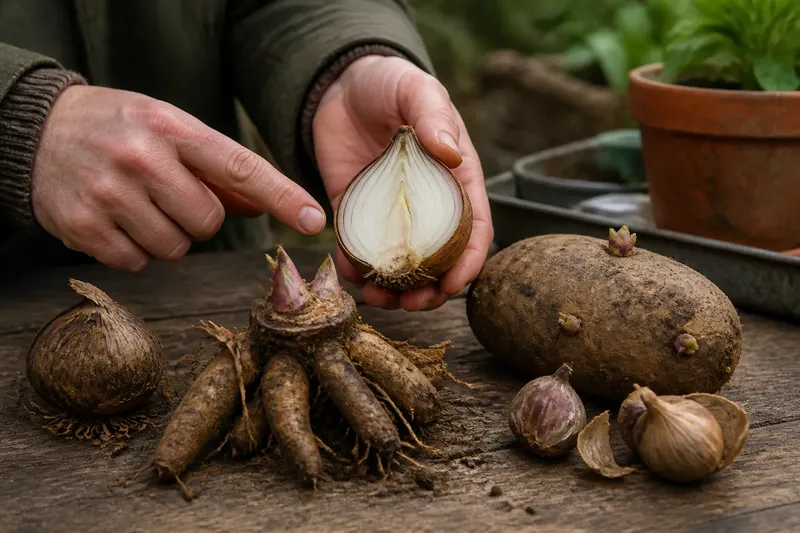
The common mistake with bulbs or tubers is to call every rounded underground plant part a bulb. That can leave you unsure where shoots will emerge and which part needs to stay intact. Look instead at the structure: a true bulb has fleshy leaf bases around a short stem, while a tuber is a swollen storage organ with a different pattern of buds.
Bulbs or tubers begin with different structures
Slice a typical bulb lengthways and its layers make sense. At the base is a flattened stem, often called the basal plate. Fleshy scales rise from it; these are modified leaves that store food. A bud sits within the layers, ready to grow when conditions suit the plant.
An onion and a daffodil are familiar examples. The papery outer covering on many bulbs is a dry protective layer, not the part that produces the next shoot. Roots can form from the basal plate, while the central or tucked-away bud grows into a leafy shoot and may produce a flower stem.
Not every bulb looks like a neat onion. Some have loose scales; others are enclosed in a tunic. The defining feature is the arrangement of fleshy leaf bases around a short stem, with the growing point held inside.
Tubers store food in swollen tissue
A tuber is a swollen storage organ, but it is not made of stacked fleshy leaf bases. The familiar potato tuber is a thickened underground stem. Its small indentations, called eyes, are buds; shoots can emerge from several points across its surface.
Other plants have tubers with different origins. A dahlia’s storage tubers are thickened roots attached to a crown, the junction where stems and roots meet. The roots themselves do not carry the buds needed to start a new plant; those are found at the crown. A detached swollen root without a piece of crown may therefore store food but lack a growing point.
“Tuber” describes a storage form, not just one botanical structure. Stem tubers and root tubers both hold reserves, yet their buds are located differently. The plant’s structure, rather than its size or shape, is the reliable clue.
Follow the buds to tell how growth begins
A bulb uses its enclosed bud and stored leaf tissue. The shoot pushes up from the centre or neck, while roots develop from the basal plate. The scales support early growth and may shrink as the plant uses their reserves. Many bulbs can also form smaller offsets beside the original, each with its own growing point.
A stem tuber can send shoots from several buds across its surface. A potato eye is a visible reminder that shoots may emerge from different points. In a root tuber such as dahlia, a new shoot comes from a bud on the crown rather than from every swollen root.
Say you find two dormant pieces in a paper bag: one has a papery coat and narrow base; the other is an irregular cluster of thick roots attached to a stubby crown. The first is likely a bulb, with its shoot protected inside the layers. The second fits a root-tuber pattern, with buds at the crown. The observable result is a useful distinction between a protected central growing point and buds at a root-and-stem junction; the outer shape alone would not settle it.
Use these observations to decide what you are looking at
- Check for layers and a basal plate. If fleshy scales surround a flattened base, identify the structure as a bulb; if the body is solid and swollen, inspect its buds instead.
- Check where the buds sit. If several visible eyes mark a potato-like body, treat it as a stem tuber; if there is no clear bud, avoid assuming the swollen part can grow on its own.
- Check for a crown. If thick roots join a crown with visible buds, identify the growing point at that junction; if the crown is absent, do not assume a root will sprout.
- Check where roots emerge. If roots arise from a bulb’s basal plate, that supports the bulb identification; if roots attach along an enlarged root, look for a crown or another stem connection.
- Check the plant name against its structure. If the label calls a planting part a “bulb” but the organ is solid, use the more precise term corm or tuber when you can identify it; if the structure is unclear, retain the label and consult the plant’s care guidance.
- Check whether inspection could cause damage. If a healthy specimen would need cutting or breaking to reveal a tiny growing point, leave it intact and use the plant’s name and supplier’s directions; if it is already loose and damaged, inspect the exposed surface gently.
There is little value in cutting open every dormant plant just to settle a label. For many garden decisions, knowing the plant’s name and following its care guidance is enough. Dissection is not worth the effort if it might damage a healthy specimen or expose a small, hard-to-see growing point.
Why are corms and rhizomes different from bulbs and tubers?
How does a corm differ from a bulb?
A corm is a swollen, solid stem rather than a layered structure of fleshy scales. It may have a dry, papery covering that makes it resemble a bulb from the outside, but its interior is solid rather than layered.
Is a rhizome a kind of tuber?
A rhizome is a horizontal stem that grows at or below the soil surface, often with buds and roots along it. It can store food, but its elongated, branching form differs from the swollen body of a tuber.
Can one plant have more than one storage structure?
Yes. Some plants combine a storage organ with roots, a crown or other stems, and these parts can be mistaken for one another when lifted together. Follow the connection between the buds and swollen tissue to identify which part can produce a shoot.
Does “bulb” always mean a true bulb?
Not in casual gardening speech. People sometimes use “bulb” for several dormant underground planting parts, but the stricter botanical distinction separates layered bulbs from corms, tubers and rhizomes.
Planting bulbs or tubers depends on their growing points
The structure explains why planting instructions can differ. A bulb’s basal plate needs to face down so roots can form there and the shoot can rise from the bud. A tuber with several eyes has no single layered top and bottom in the same sense, while a root-tuber cluster depends on keeping its crown and buds intact. Follow the plant’s label or supplier’s directions for depth and orientation, since those details vary by plant.
When a name seems confusing, ask what is swollen and where the buds are. A bulb stores food in fleshy leaf bases around a short stem. A tuber stores food in a swollen organ, with buds positioned on a stem tuber or at the crown of a root-tuber plant. That distinction helps you read the structure beneath the soil and avoid mistaking stored food for a growing point.